Blog ≫ 2026 ≫ What's the best radio for the impending zombie apocalypse?
Everyone's talking about getting a proper radio for emergencies. We're a bit too used to internet for everything. We listen to the radio a lot, but through a smart speaker, which relies on internet. What if that goes down? I asked the google, while it's still there:
For a UK-based emergency or survival scenario, the best radio balances reliable multi-power options (like AA/AAA batteries alongside solar or hand cranks) with the ability to tune into local FM and BBC broadcasts.
Top Radio Recommendations for the UK
- Midland ER310 Pro / ER310: Widely considered the best all-around emergency radio, featuring a massive 10,000mAh battery (good for hundreds of hours of playback), USB-C device charging, a hand crank, solar panel, torch, and FM/MW reception.
- Philips TAR3500: A rugged, IP55 dust- and water-resistant portable radio that runs for up to 60 hours on a single charge, features an AM/FM tuner, and can be powered via USB-C, solar, AAA batteries, or a hand crank. It also includes an orange SOS emergency siren and a phone-charging USB-A port.
- Kaito KA500 Voyager: A durable, multi-power survival radio (solar, hand crank, USB, AC, and 3x AAA batteries) with AM/FM and shortwave bands, making it great for extended off-grid situations.
- Yaesu FT-60R (Ham / Two-Way): If you need to transmit voice rather than just listen, a rugged handheld amateur ham radio like the Yaesu FT-60R offers superior frequency agility, local VHF/UHF line-of-sight communication, and independence from ground wire networks.
Key Survival Radio Features to Consider_
- Power Sources Beyond the Crank: Wind-up hand cranks are useful in a pinch, but built-in rechargeable batteries degrade or go flat over time. Look for models that also accept standard AA or AAA alkaline batteries, which can sit in storage for years and work the moment you need them.
- UK Frequency Reality Check: Skip American-market radios that heavily advertise NOAA weather alerts—those weather transmitter networks do not exist in the UK. Instead, prioritize clear FM reception to tune into local BBC news and emergency briefings.
- Avoid DAB/DAB+ for Survival: While digital radio is great for everyday use, DAB drains battery power and hand-crank energy much faster than traditional analogue FM/AM bands.
- Durability & Utility: Water resistance (IPX4 or IP55 ratings), a built-in LED flashlight, an SOS beacon, and a USB power bank to top up your mobile phone add vital multi-use capability.
I'll probably be ignoring all this and keeping the DAB+ for now, as long as I can find one to do both, as 99.99% of this radio's use would be in a non emergency situation still plugged in to the mains. We can shift to FM when we have to. What about medium wave or long wave, is that still a thing?
Looking for that top example on amazon, I find this one at £128 1... but look at the price history there! It was £50 in July.
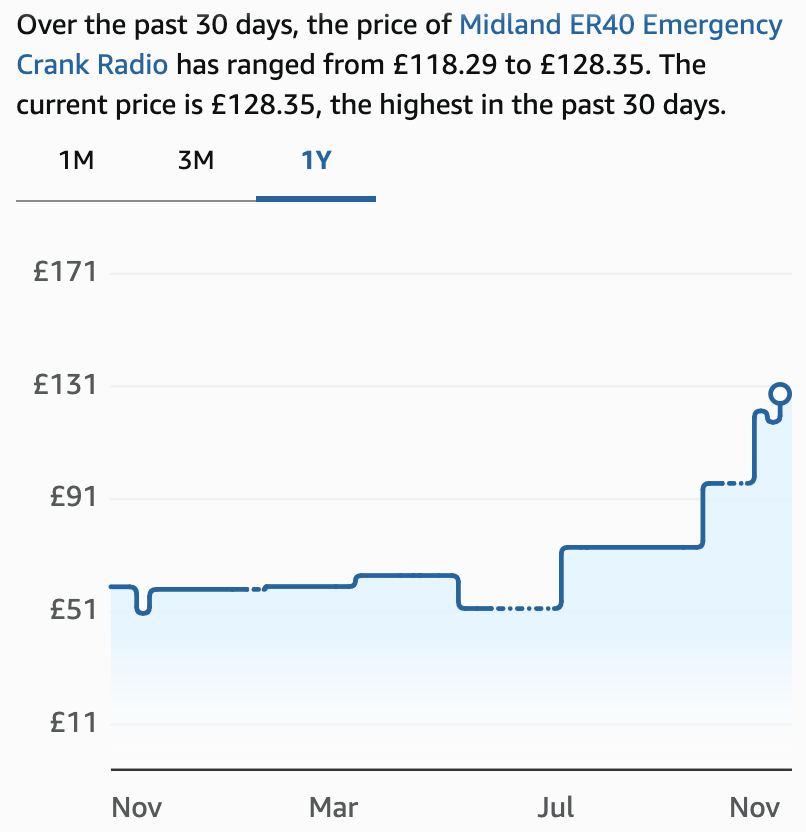
I think I am going to look for a Roberts one that is rechargeable or takes batteries. All the recommended emergency wind up radios are out of stock. By the time I choose one the zombies will be here.
Oh of course the little boom box T1 just got has got a radio on it, now how many batteries will that need..?
Time to stop looking at this stuff and make the dinner. Sausage and mash today.
- As an Amazon Associate, I earn from qualifying purchases. In theory…
Thick cloud and a gentle breeze, 9 - 11℃.
⬅️ Another legit competition prize :: Exercise stats 2/11/26 ➡️